













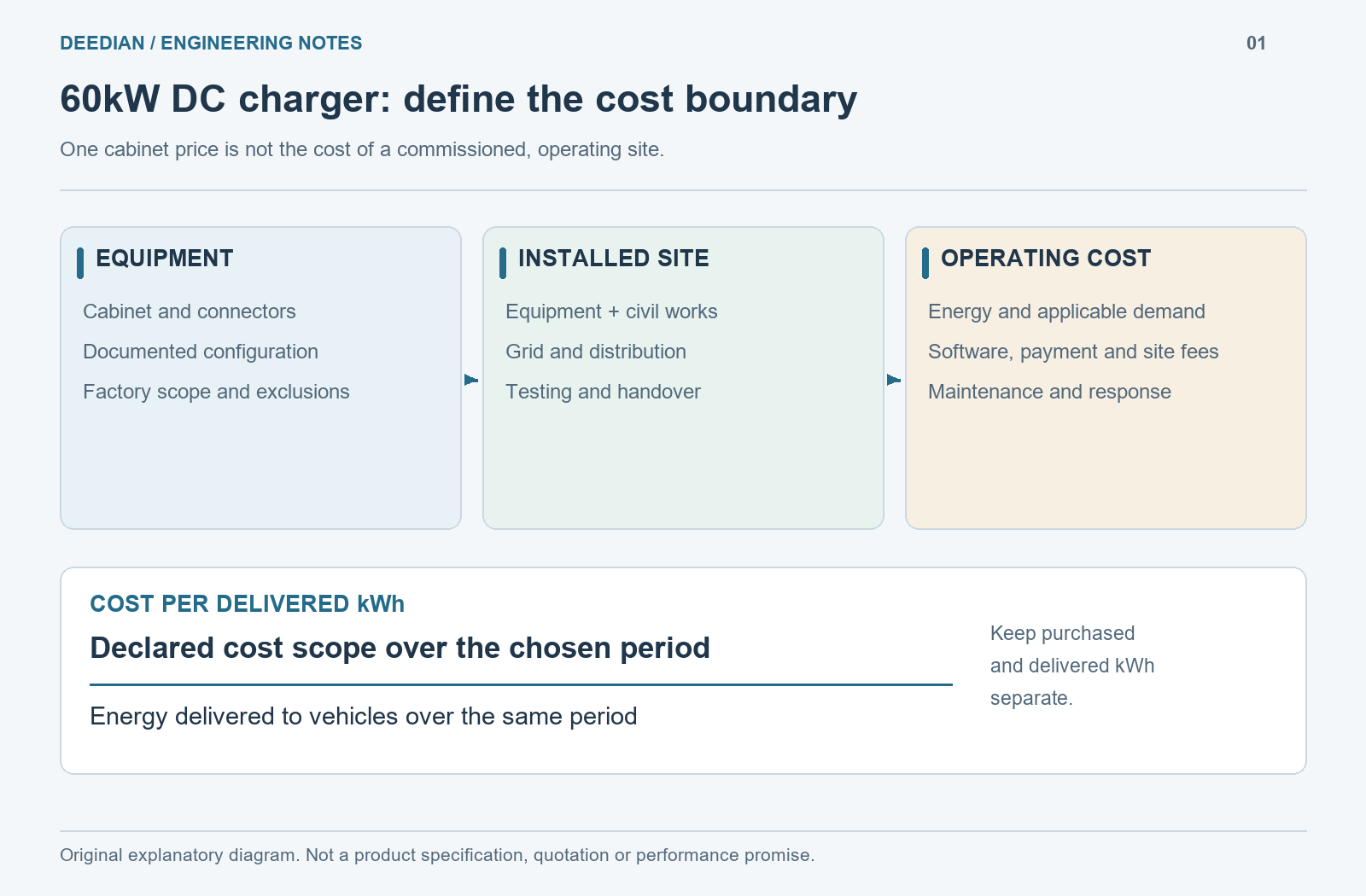
The cost of a 60kW DC charger is not one number. A useful budget separates the charger cabinet, site installation, grid work, commissioning, and the ongoing cost of each delivered kilowatt-hour. The same cabinet can be inexpensive to place beside an adequately sized electrical room and expensive to deploy across a long trench or constrained utility connection. This guide gives buyers a disciplined way to compare quotes without inventing a price band: define the physical scope, distinguish power from energy, and calculate a transparent unit cost from your own assumptions. It also explains why a two-gun cabinet may share power rather than deliver 60kW to each vehicle.
What a 60kW DC charger quote should include
Start by asking what the supplier means by “equipment.” A line labelled charger may include a power cabinet, dispenser, cables, connectors, control board, protection components, communications hardware, and factory testing. It may exclude freight, unloading, foundations, bollards, trenching, distribution equipment, transformer work, permits, inspection, network setup, and commissioning. Comparing the headline number alone creates a false saving: a cheaper cabinet can require more site scope before it can safely energize.
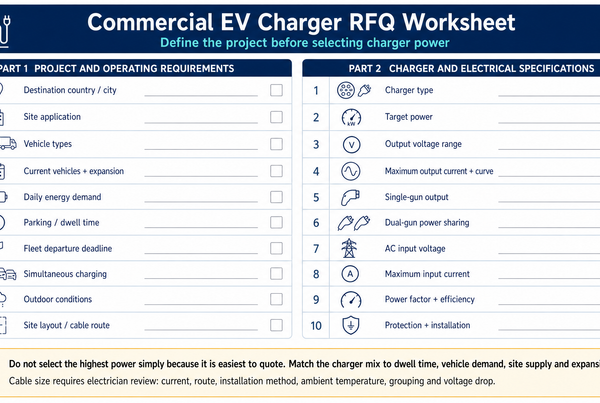
Build a scope sheet with separate columns for included, excluded, owner-supplied, and allowance. Record the rated DC output, number of connectors, simultaneous charging behavior, input voltage range, maximum AC input, enclosure requirements, cable reach, ambient operating envelope, communications interfaces, and software responsibilities. “Two guns” describes connection options, not a promise that both vehicles receive full output. If both cars are charging, the cabinet may divide available power according to its control logic and each vehicle’s request. Vehicle battery limits and temperature can reduce actual power further.
The electrical path deserves its own review. AFDC procurement guidance treats utility coordination, a qualified electrical contractor, permits, inspections, site conditions, networking, ownership, and ongoing operation as planning items rather than afterthoughts. A site assessment should therefore verify the existing service, measured site load, protection arrangement, cable route, metering, communications signal, drainage, lighting, and vehicle circulation. Do not size a transformer or cable from the DC label alone. The responsible local engineer must account for AC input, efficiency, diversity, other building loads, code, fault protection, voltage drop, and future expansion.
A practical request for quotation asks for two totals: equipment-only and installed-to-commissioned. Ask whether the second total includes engineering drawings, utility application support, civil restoration, testing, software configuration, staff orientation, and documentation. Request assumptions beside every allowance. If a quote says “electrical works as required,” it is not comparable until the bidder describes what was inspected and what remains unknown. For a 60kW EV charger, also ask whether the quoted control system changes its output when two vehicles connect.
How to calculate DC charging cost without hiding the denominator
“Cost per charger” and “cost per kWh” answer different questions. The first helps compare procurement offers. The second tests operating economics and should use energy actually delivered to vehicles, not just the cabinet’s nameplate or electricity purchased at the meter. Track both purchased kWh and delivered kWh because conversion losses, standby consumption, and auxiliary loads belong somewhere in the operating model.
Use this simple illustrative formula:
Cost per delivered kWh = (energy bill + demand-related charge + network/payment fees + maintenance reserve + site allocation) ÷ delivered kWh
This is a hypothetical planning example, not a market quote. Assume a site delivers 9,600 kWh in one month. The operator’s assumed monthly energy bill is 1,920 currency units, demand-related charge is 360, network and payment fees are 240, maintenance reserve is 180, and site allocation is 300. The result is (1,920 + 360 + 240 + 180 + 300) ÷ 9,600 = 0.3125 currency units per delivered kWh. Change the delivered energy or tariff structure and the result changes immediately. A quote should not claim a universal cost per kWh without stating these inputs.
For a capital view, allocate installed capital over a chosen analysis period and expected delivered energy, while labelling assumptions about financing, residual value, utilization, and downtime. A simplified illustrative calculation might divide 100,000 currency units of installed capital by 1,200,000 expected delivered kWh over the analysis period, producing 0.083 currency units per kWh before financing and taxes. That figure is not a forecast; it is a sensitivity input. Run low, base, and high delivery cases, and show how fixed site costs spread as energy volume changes.
Keep demand and energy distinct. A utility may bill energy in kWh and also assess a demand component based on a peak interval. DC fast charging is more likely to create a demand peak than slower charging, but the exact tariff is jurisdiction-specific. Obtain the current tariff sheet and ask the utility how a new load is classified. Time-of-use periods, demand ratchets, taxes, and service charges can change the numerator, meaning the cost total, not the delivered-kWh denominator. Never replace a local tariff review with a generic internet estimate.
How to compare a 60kW DC charger project before signing
Compare proposals in four layers. First, compare delivered capability: output range, connector count, power sharing, vehicle communication, environmental limits, and the difference between rated and sustained performance. Second, compare site readiness: service capacity, transformer or switchgear changes, trench length, civil work, permits, inspection, and utility schedule. Third, compare operational ownership: who monitors faults, handles payment issues, supplies spare parts, responds on site, and pays after any stated warranty period. Fourth, compare evidence: test reports, manuals, wiring information, cybersecurity responsibilities, communications version, and commissioning acceptance criteria.
OCPP should be treated as a testable interface, not a blanket guarantee of interoperability. Specify the actual version, supported functions, certificate or security method where relevant, and the CSMS test cases required before acceptance. Define what “online” means: a visible heartbeat is not the same as a successful authorization, power session, meter record, and settlement. AFDC operations guidance emphasizes maintenance, network fees, pricing, utilization data, and responsibility for repairs. Put these duties in writing instead of assuming the equipment seller owns them forever.
Create a risk register before comparing the final totals. Unknown utility capacity, an unconfirmed cable route, seasonal weather, vandalism exposure, payment failure, and parts lead time each deserve an owner and a decision date. If a site is public, model queueing and access; if it serves a captive fleet, model dispatch windows and vehicle compatibility. A business plan for an EV charger should connect demand evidence to this scope, while an EV charger operating cost budget should carry the recurring lines forward.
Also request a commissioning record that states the measured input, delivered output, connector behavior, meter accuracy, alarms, and communications result. A 60kW EV charger should be accepted against observable tests, not a marketing description. Keep the signed scope, drawings, serial numbers, test results, and training record together. These documents help the owner troubleshoot later and give the next service provider a factual starting point. They also make a future expansion decision easier because the site team can see what was actually installed rather than relying on memory.
The strongest procurement decision is not automatically the lowest equipment quote. It is the proposal whose assumptions can be checked, whose exclusions can be priced, and whose operating responsibilities remain clear after commissioning. When comparing a 60kW EV charger, keep the equipment comparison separate from the site comparison so a low cabinet figure does not disguise a high installation burden. If you are preparing a project, submit the site type, vehicle mix, target connectors, available electrical information, expected energy, country, and preferred commercial model to Deedian for a model-specific review. Ask for an itemized scope and a calculation you can challenge. That is how to turn 60kW DC charger planning into a defensible installed budget and a measured DC charging cost per delivered kWh.