












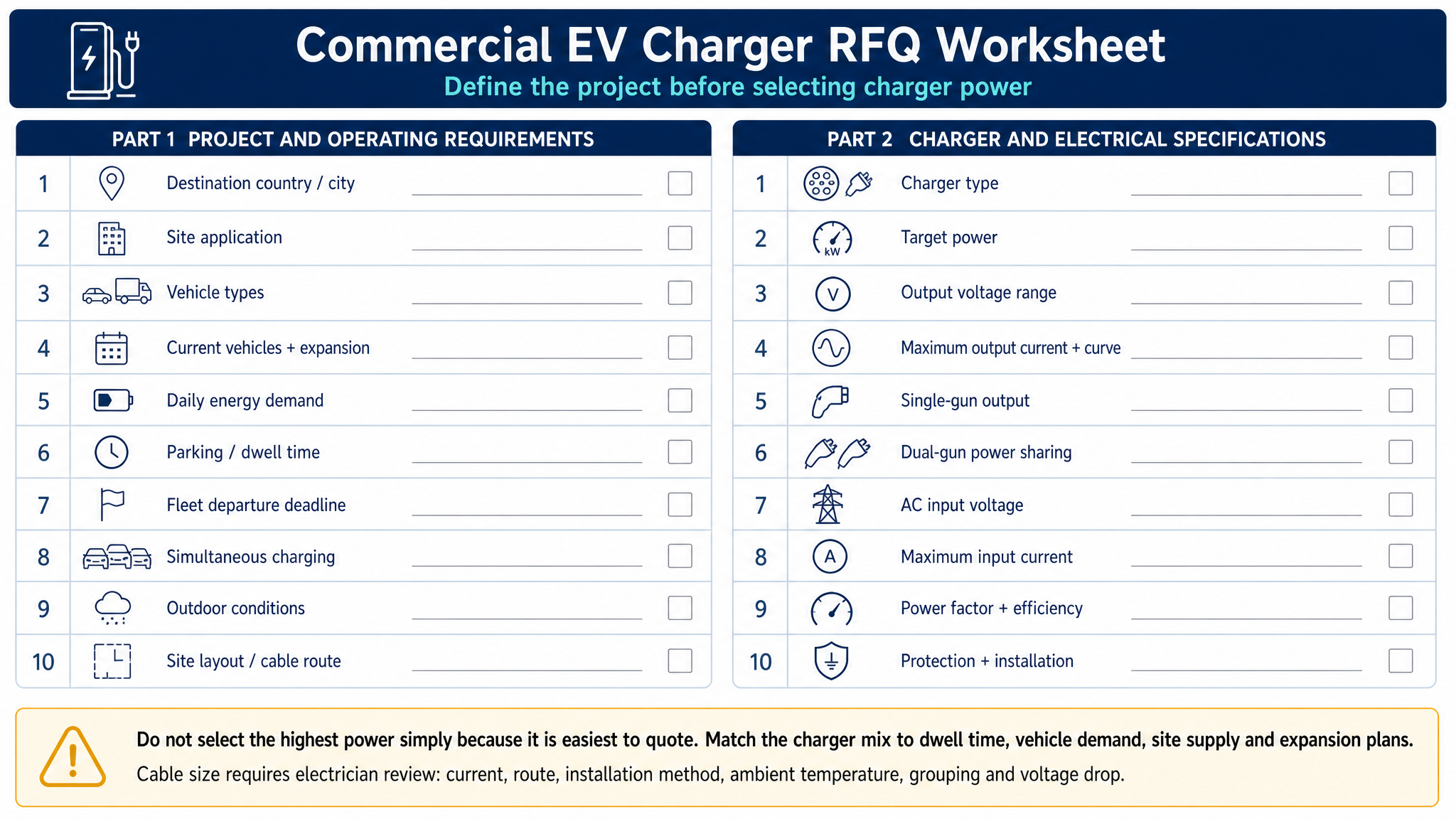
A vague request for “a 120kW commercial EV charger” produces vague quotations. A useful commercial EV charger RFQ tells suppliers what the site must do, which vehicles it serves, how many sessions may run together and what documents the buyer needs. This checklist helps CPOs, distributors, EPC contractors, fleet operators and public-project buyers compare the same scope.
Use the first 10 items to define the service, the next 10 to define the hardware and the last 10 to define delivery and support. If a requirement is unknown, mark it as open instead of allowing each supplier to make a different assumption.
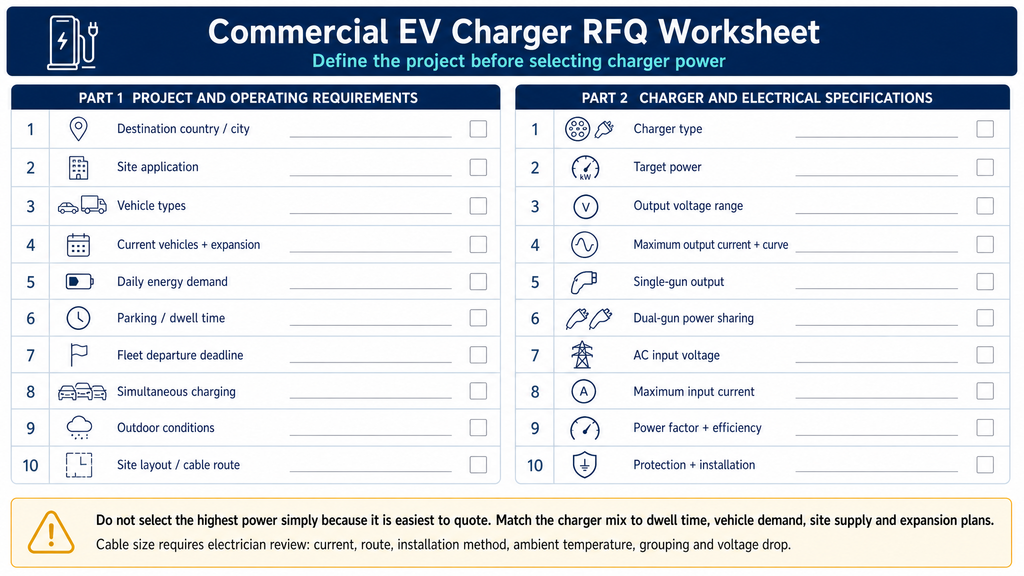
Part 1: Project and operating requirements
- Destination country and city: Electrical, connector, payment and compliance requirements depend on the market.
- Site application: Public station, fleet depot, workplace, hotel, retail, bus, truck or dealership.
- Vehicle types: Passenger cars, vans, buses, trucks or mixed fleet.
- Number of vehicles: State current quantity and expected expansion.
- Daily energy demand: Give expected kWh per day or an operating range.
- Parking or dwell time: Note average and shortest charging window.
- Departure deadline: Fleet projects need the latest time vehicles must be ready.
- Simultaneous charging: State how many vehicles may connect during the busiest period.
- Outdoor conditions: Temperature, rain, dust, salt, altitude and flood risk.
- Site layout: Provide a drawing or approximate cable length, vehicle flow and charger position.
These items stop a supplier from recommending the highest power simply because it is easy to quote. A fleet with overnight parking may use a different mix from a highway site with short stops.
Part 2: Charger and electrical specifications
- Charger type: AC, DC, portable, wall-mounted, floor-mounted or split system.
- Target power: For an EV DC charger, state whether you need 60kW, 120kW, 160kW or another rating.
- Output voltage range: Confirm compatibility with the intended vehicles.
- Output current: Ask for maximum current and the operating curve.
- Single-gun output: State the required power when one vehicle is connected.
- Dual-gun power sharing: Ask whether two vehicles charge simultaneously and how power is allocated.
- AC input voltage: Specify nominal voltage, tolerance, frequency and phase.
- Maximum input current: Use the exact model datasheet, not the output rating alone.
- Power factor and efficiency: Request values at representative loads.
- Protection and installation: Confirm breaker, grounding, surge protection, isolation, ventilation and mounting requirements.
The EV charging station cable size should be calculated from current, route, installation method, ambient temperature, grouping and voltage drop. Do not accept a generic cable number without the project electrician’s review.
Part 3: Connectors, software and user access
- Connector standard: CCS2, CCS1, GB/T, NACS or another approved configuration.
- Cable length: Confirm standard length, flexibility and replacement option.
- Communication protocol: State the required OCPP version and required functions.
- CSMS compatibility: Name the intended backend and test requirements.
- Remote commands: Check start, stop, reset, diagnostics and firmware functions.
- Load management: Specify site limit, meter interface, dynamic control and failure behavior.
- User authentication: QR code, RFID, PIN, mobile app or open charging.
- Payment: POS, online payment, pre-authorization, refund and receipt requirements.
- Screen and language: Confirm display size, local language, branding and accessibility.
- Tariff configuration: State energy price, service fee, time-of-use rule, tax and currency needs.
An OCPP EV charger manufacturer should provide a function matrix for the exact model. “OCPP ready” is not enough if the project needs smart charging, offline transactions, meter values or a specific payment flow.
Add the commercial terms to the same RFQ
The technical list is incomplete without delivery and support. Add model-specific certificates, test reports, factory inspection, packaging, Incoterm, lead time, sample approval, warranty, spare parts, remote support, training and the definition of a warranty failure. For an EV charger manufacturer for distributors, also add branding files, minimum order quantity, territory, price validity and change-notification procedure.
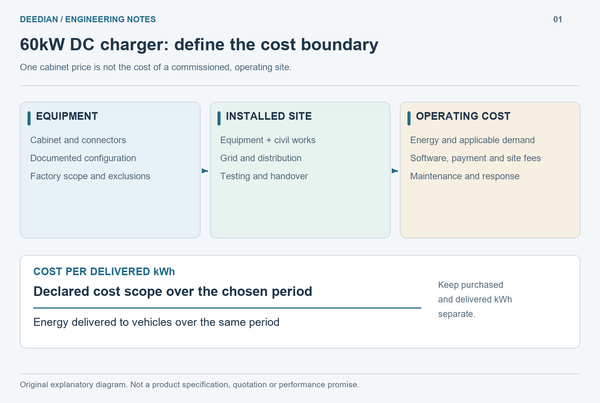
Ask every supplier to label included, optional and excluded items. Compare supply-only, engineering-only and turnkey offers separately. The cheapest unit may not be the lowest installed or operating cost.
How to evaluate the answers
Score each quotation against the same RFQ. A supplier should answer every item or mark it as an exception. Check that the certificate, datasheet, product photo and quote all refer to the same model. Compare the power curve, not only the headline kW. Verify whether the quoted price includes connector, cable, payment terminal, communication modem, mounting kit and commissioning.
For a first sample, test vehicle communication, output, protection, payment, OCPP, EV charger power sharing, error recovery and documentation. A sample that passes a factory demonstration may still need local backend and vehicle testing. Keep a signed comparison sheet showing the accepted model, firmware, connector, cable, output allocation and open exceptions. If a supplier proposes a substitute component, ask whether the change affects certification, power performance, software or spare parts before accepting it.
Deedian can review a commercial charger RFQ for 60–160kW floor-mounted DC projects, subject to model-specific technical documents and local engineering approval. Send the destination market, vehicle group, site power and planned quantity for a configuration review. Include the target delivery date, whether the quotation is supply-only or turnkey, the requested Incoterm, spare-parts expectations and the person responsible for local commissioning. These details help the supplier separate a product quotation from a complete project proposal and reduce later changes to scope.
Frequently Asked Questions
Why should an RFQ ask for simultaneous output?
Because two connectors do not always provide two independent full-power sessions. Power may be shared by the cabinet or limited by the site.
Is an RFQ checklist the same as a compliance approval?
No. It organizes project requirements. The importer, engineer and local authority must confirm the applicable approvals and installation rules.