












For Charging Point Operators (CPOs), fleet owners, and regional distributors, transitioning from initial market evaluation to a large-scale commercial deployment is a significant investment. Before committing to a multi-unit or container-load order, purchasing a sample unit is standard procedure.
However, many B2B buyers make a costly mistake: they treat the sample order merely as a hardware test.
While verifying charging speeds and protection levels is essential, the sample phase is actually a comprehensive stress test of the manufacturer’s entire supply chain, engineering responsiveness, and quality control systems. A single flawless sample created in a laboratory does not automatically guarantee that 100 units will perform with the same precision on-site.
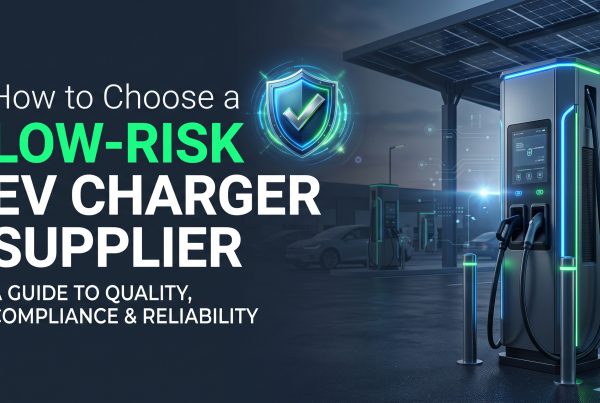
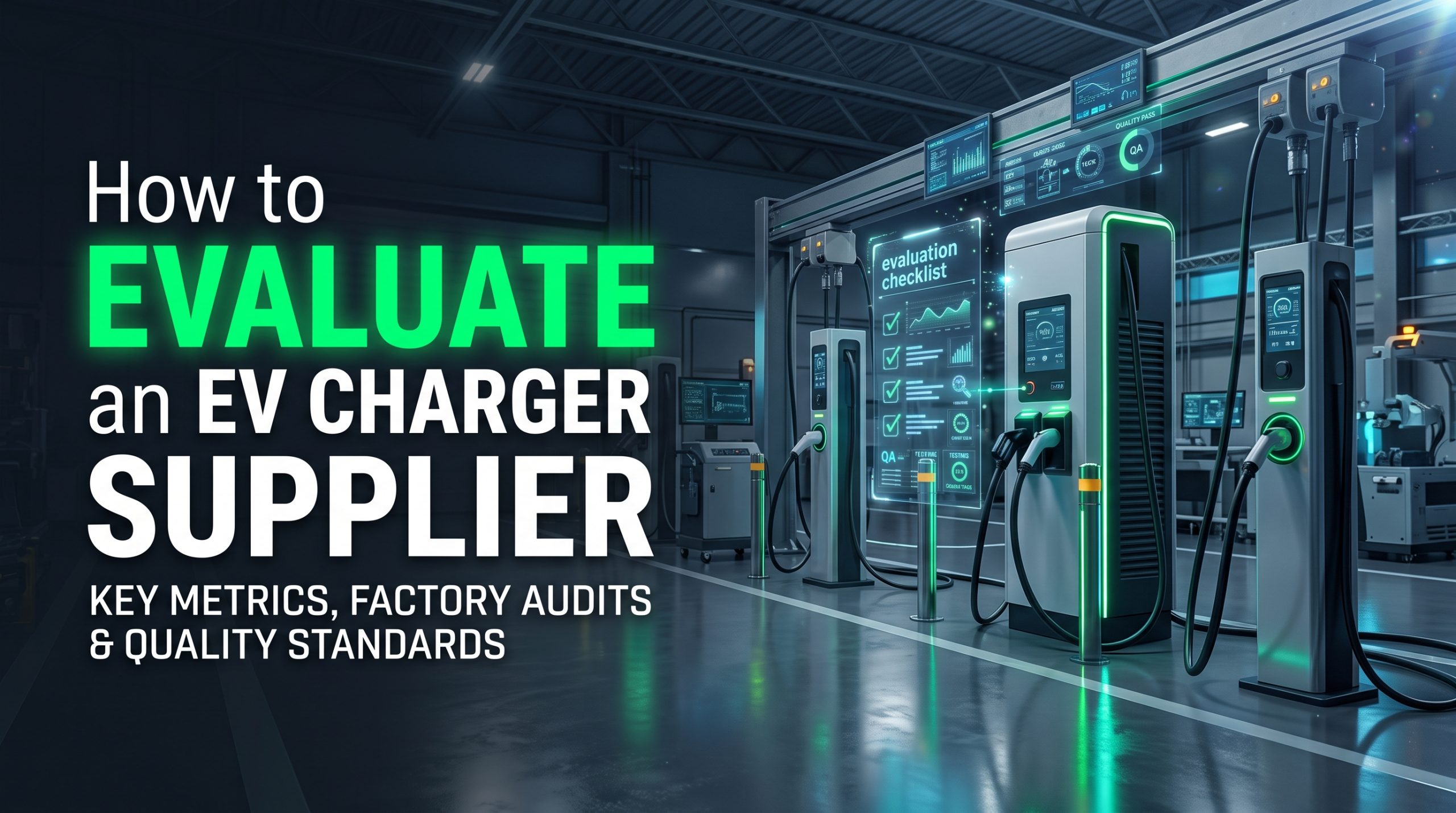
To minimize procurement risk, here is a structured guide on how to evaluate an EVSE (Electric Vehicle Supply Equipment) supplier before and after the sample order to determine if they are ready for bulk cooperation.
Phase 1: Pre-Sample Evaluation — What to Verify Before Placing the Sample Order
Before spending money and time on sample shipping and testing, conduct a rigorous preliminary screening. A high-reliability manufacturer should demonstrate professional maturity during initial discussions.
1. Transparency in Technical Specifications
A capable supplier does not offer generic brochures. They provide comprehensive technical datasheets specifying:
Core Components: Brands of power modules, relays, air switches, and main controllers.
Protections: Details on over-current, over-voltage, leakage protection (Type A or Type A + DC 6mA), and IP/IK ratings.
Firmware & Protocol Support: Standard integration of OCPP 1.6J/2.0.1 and vehicle communication compatibility (GBT, CCS2, CHAdeMO, or NACS).
2. Customization & OEM Alignment
If your project requires localized UI/UX display languages, specific cable lengths, dynamic load management, or custom enclosure branding, confirm whether these can be pre-configured on the sample. If a manufacturer hesitates to customize a sample, scaling those modifications for bulk production will be even more challenging.
3. Clear Lead Time and Packaging Commitments
Notice how the supplier handles sample lead times and packaging specifications. Industrial-grade DC chargers (such as 60kW–960kW commercial units) require solid wooden crate packaging and anti-vibration protection during transport.
Phase 2: Post-Sample Evaluation — Testing the Hardware & The Vendor Process
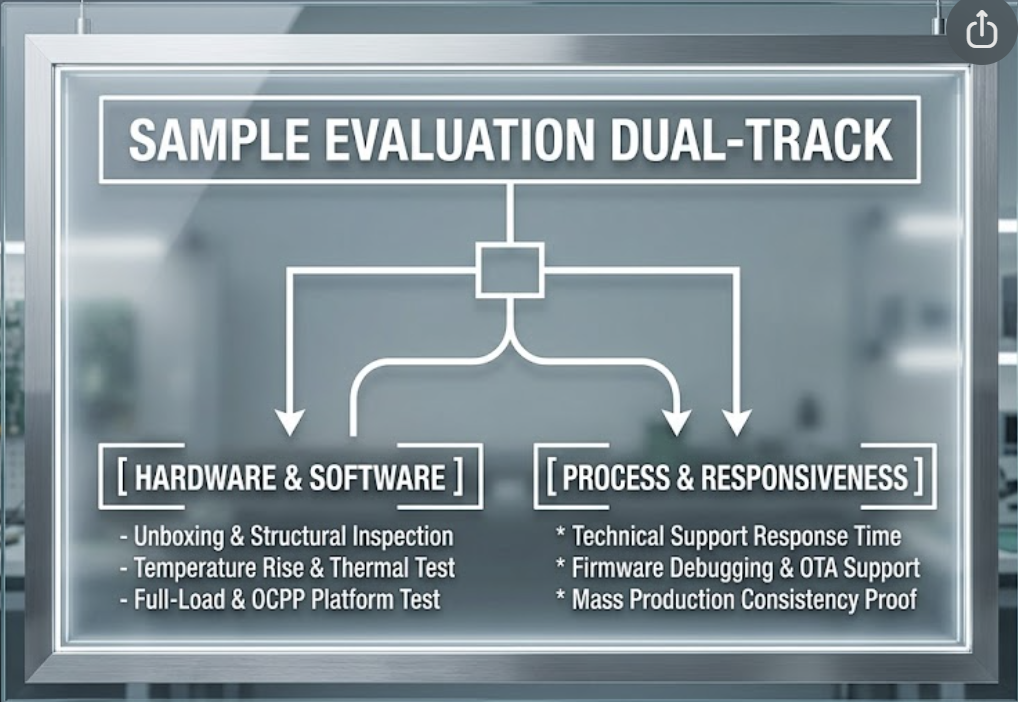
Once the sample arrives, your evaluation shifts into a dual-track assessment: Hardware Performance and Process Capability.
A. Hardware & Structural Inspection
Don’t just plug the unit in—inspect its physical assembly and internal architecture:
Build Quality: Inspect metal enclosure seams, paint durability, sealing gaskets, and cable strain reliefs (crucial for IP54/IP55 outdoor standards).
Internal Wiring & Layout: Open the enclosure (if authorized). Look for neat wire routing, clear labeling, proper grounding, and industrial-grade terminal blocks.
Thermal Performance: Run the charger at full load (e.g., 120kW split across dual guns) for several hours to measure temperature stability in power modules and connectors.
B. Software & Protocol Interoperability
Connect the charger to your chosen CSMS (Charging Station Management System) via OCPP 1.6J/2.0.1. Test remote authorization, real-time status updates, remote start/stop, and firmware updates (OTA).
C. Technical Support Responsiveness (The True Test)
During sample setup, deliberately present a complex scenario or technical question to their engineering support team.
Did they reply within hours with actionable engineering insights, or did they give vague sales answers?
Can they assist with remote logs and parameter adjustments?
Phase 3: Transitioning from Sample Success to Bulk Order Confidence
If the sample meets all technical requirements, how do you ensure that a 50-unit or 100-unit production run matches the sample’s quality? Ask the manufacturer for these three bulk quality guarantees:
| Evaluation Criteria | Red Flag (High Risk) | Best Practice (Deedian Standard) |
| Component Consistency | Uses substitute or unverified power modules in bulk orders | Strictly locks BOM (Bill of Materials) after sample approval |
| Aging Test Coverage | Sample-only testing; quick checks on mass production | 100% Full-load aging and burn-in testing for every production unit |
| Traceability | No serialized logging of individual components | Full serial number (SN) tracking linking quality reports to each unit |
Key Rule for B2B Buyers: Request a BOM Lock Agreement prior to issuing a bulk purchase order. This ensures that the exact power modules, controllers, and protective components tested in your sample are used across the entire mass production batch.
Summary Checklist: Is Your Supplier Ready for Bulk Purchase?
[1] Pre-Sample: Datasheets are clear, options for dynamic power balancing/OEM are confirmed, and packaging meets international shipping standards.
[2] Sample Hardware: Structural seals pass outdoor standards, internal wiring is tidy, and thermal performance is stable under continuous heavy load.
[3] Sample Software: OCPP connection with your backend platform is seamless, and remote diagnostics function as expected.
[4] Supplier Process: Engineering support was fast and knowledgeable throughout the testing phase.
[5] Bulk Readiness: Factory commits to 100% full-load burn-in testing and locked BOM management.
Partner with Deedian: Reliable Engineering from Sample to Bulk Deployment
At Deedian (Huizhou Deedian New Energy Technology Co., Ltd.), we understand that a sample order is the foundation of long-term trust. We build our entire manufacturing process to ensure that your bulk production units match—or exceed—the performance of your sample.
Our commercial portfolio includes:
AC Chargers: 7kW–22kW for commercial parking and destination charging.
Wall-Mounted & Pedestal DC Fast Chargers: 20kW–40kW for commercial fleets.
High-Power Commercial DC Chargers: 60kW–360kW with dual-gun dynamic allocation.
Split-Type & High-Power Systems: Scalable power solutions up to 960kW.
Every Deedian charger undergoes rigorous full-load aging tests and strict quality control before shipment, ensuring reliable performance in the field.
Ready to Test Our Quality?
👉 [Request a Test Sample] – Contact our technical specialists to configure a sample unit tailored to your local grid and project requirements.
👉 [Request a Technical Datasheet] – Explore detailed mechanical drawings, component specifications, and OCPP integration guides for Deedian EV Chargers.